How to play
Buy homes. Rent them out. Earn enough to quit your job.
Your first game in 5 steps
-
Start a game
Pick a character and where in Britain you start.

-
Look at the homes
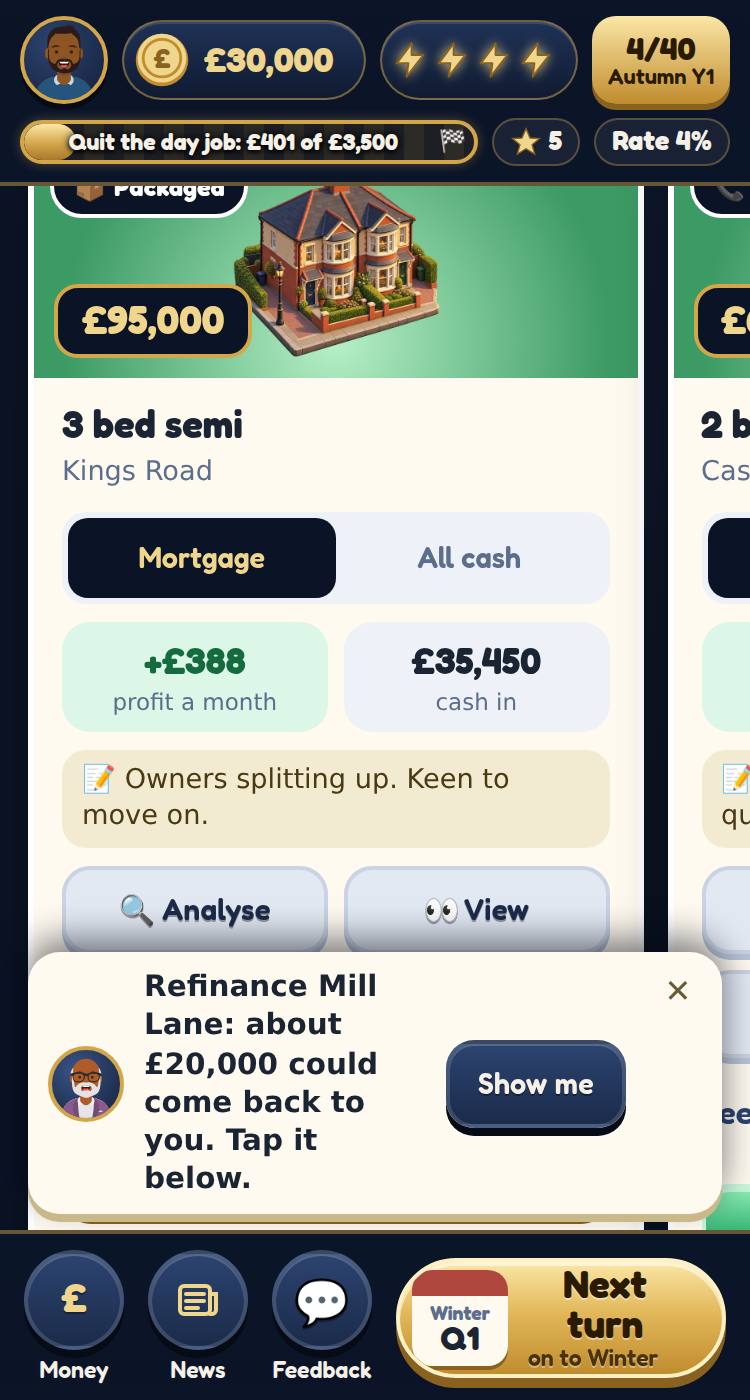
Swipe the cards to see homes for sale. Each one shows the price and how much it earns you each month.
-
Check it and ask for less
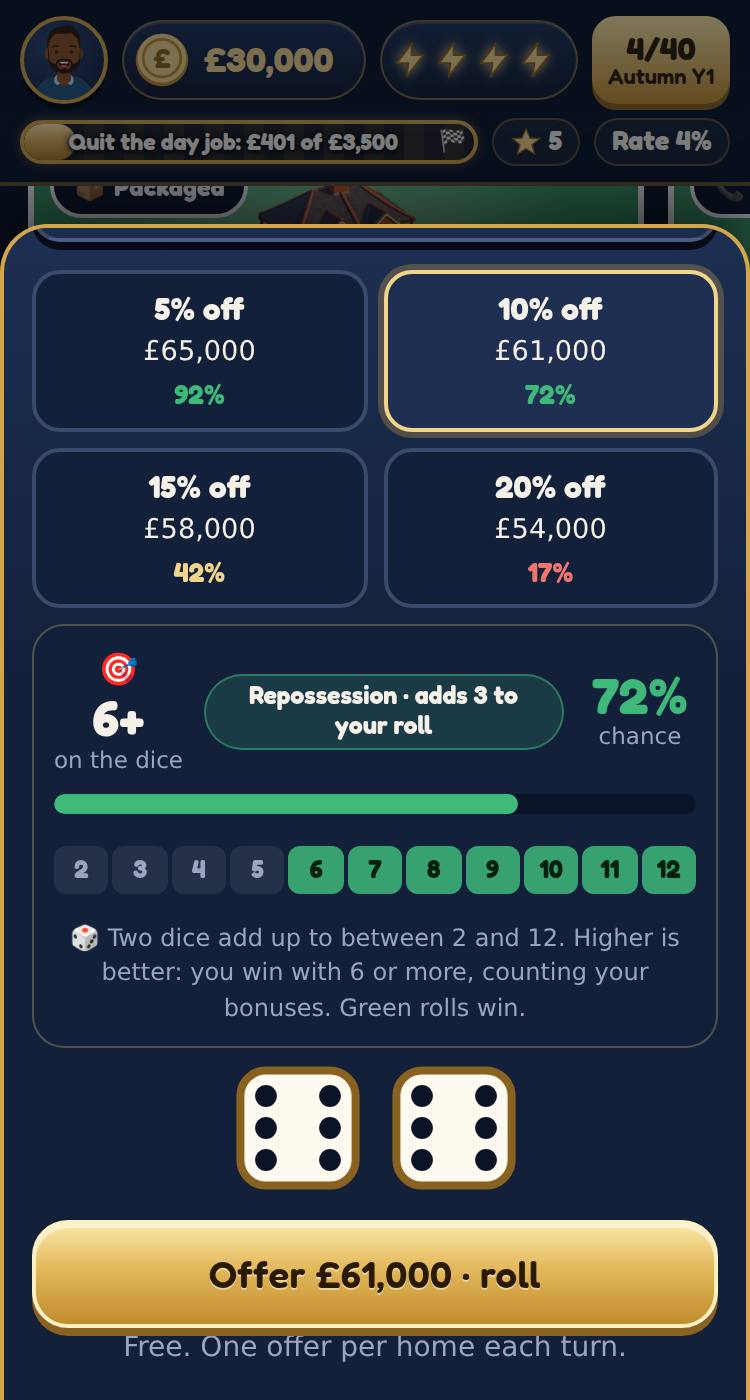
Tap View to look for problems. Then tap Haggle to ask for a lower price and roll the dice.
-
Buy it
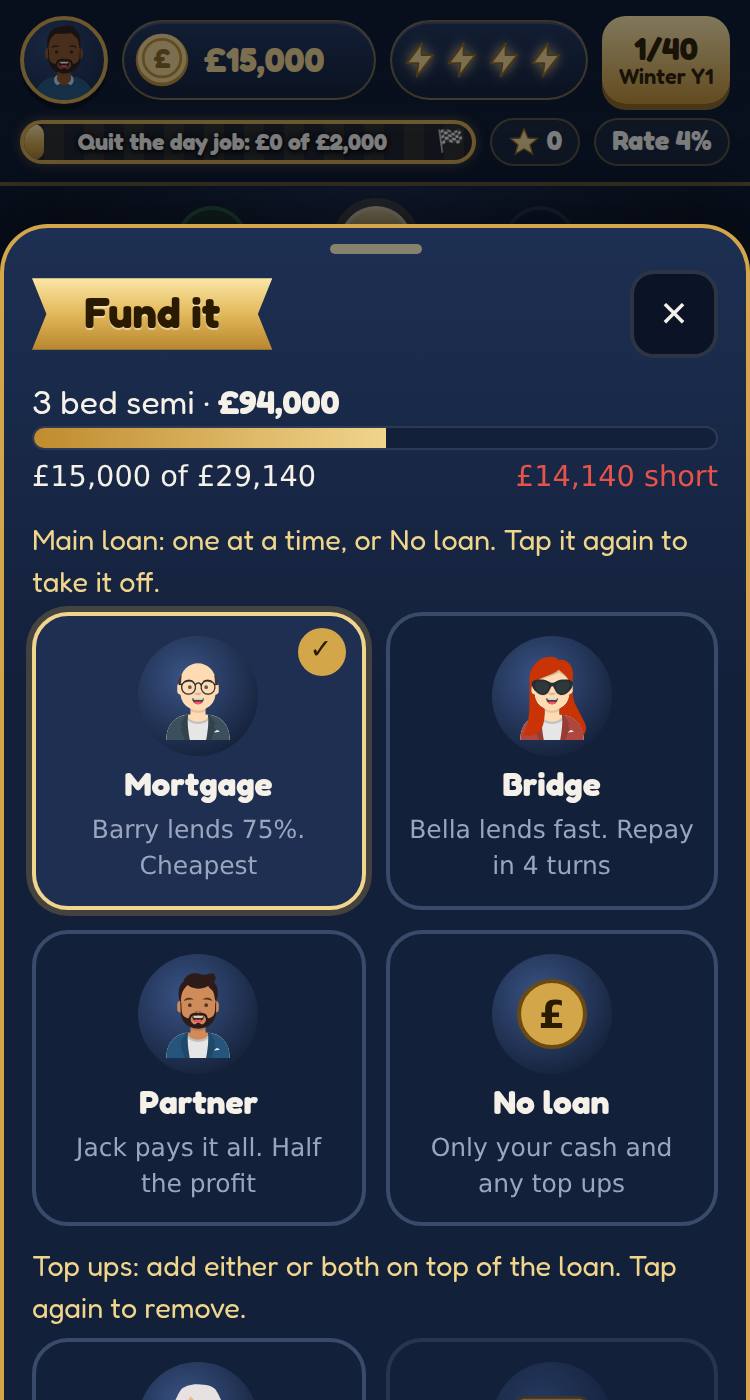
Tap Buy. Not enough money? Tap Fund it and borrow from the bank.
-
Tap Next turn
Three months pass. Your tenants pay rent. Do it again, and grow!
4 things to know
Want to know more?
Tap a heading to open it.
Newbie or Professional, and hints
- Newbie keeps tax simple: one percentage when you buy, and one rate on your yearly profit, and Mo explains each new idea the first time it comes up. Best for your first games.
- Professional plays by the real rules: Stamp Duty bands, the 22% interest credit, companies and tax on gains. The Weekly Challenge is always Professional.
- Stuck? Tap 💡 Hint on a quiz, the comparables, the works plan, the HMO planner, the advert or the VA interview. Hints come in up to 3 steps, from a nudge to the answer; each step takes 2% off your score (never more than 20% in all). Looking at a step again is free.
Words to know
Rent: money a tenant pays you each month to live in your home.
Tenant: the person who rents your home.
Mortgage: a loan from the bank to buy a home.
Interest: the extra you pay each month for borrowing.
Bargain: a home selling for less than it is worth.
Overdraft: spending more than you have. It costs interest. Stay past your limit for 2 turns and homes are sold until you are back within it. If they cannot cover the debt, you go bankrupt.
Valuing a home (comparables)
Never trust the asking price. Work out what the home is really worth from homes like it that have sold.
- On a home's card, tap 🔍 Analyse. You see sold homes nearby, called comparables.
- A good comparable is within ¼ mile, sold in the last 12 months, the same type of home and a similar size. One of them is not: tap ✗ Leave out on it.
- Each sale shows its £ per sq ft. Take the average of the good ones.
- Multiply by this home's size. Example: the good ones average £75 per sq ft, and this home is 750 sq ft, so it is worth about £75 × 750 = £56,250.
- Slide to your valuation and lock it in. Within a few percent and your Analysis skill grows, and the bank's surveyor trusts you more when you refinance.
Homes for sale nearby show asking prices: those are hopes, not what buyers paid.
Checking the yield
Yield tells you how hard a home works for its price.
- Gross yield = rent a month × 12 ÷ price × 100. Example: £535 × 12 = £6,420; £6,420 ÷ £63,000 × 100 = 10.2%.
- Net yield takes off running costs (repairs, insurance, empty months) and counts everything you paid, including purchase costs and works. The Deal Analyser works it out for you.
- Return on cash is the yearly profit after the mortgage, against the cash you put in. Borrowing raises it, and the risk.
- In the game, the cheaper northern regions have the highest yields and London the lowest, as in real life.
Each card's green box shows the profit a month, and since tax arrived, the profit after tax too.
Look past the headline. At the end of the Deal Analyser, Headline vs real takes the rent and its yield and subtracts repairs, insurance, empty months, the mortgage and tax, down to the real cash each month. A deal can look good on paper and tell a different story once everything is counted.
Viewing and haggling
- 👀 View is free. Tap the spots on the photo to look for problems such as damp, an old boiler or bad wiring. Anything you miss turns up later as an urgent repair.
- 🤝 Haggle asks for a lower price, from 5% to 20% off. The more you ask, the lower your chance. Sellers in a hurry (probate, divorce, debt, a tired landlord) say yes more often: read the 📝 note on the card.
- Off market tip offs and repossessions from the news cards come in below value.
Borrowing money
Pick one way to borrow:
- Barry the Banker gives you a mortgage. Cheapest.
- Bella the Bridger lends fast. Pay her back in 4 turns.
- Jack the Partner pays for it all. He takes half the profit. He backs up to 3 homes at once.
Still short? Add Family or a credit card. Mortgage lenders want the deposit to be your own money or a family gift, so the card works with Bella or no loan, not with a mortgage. Fund it shows every way to cover a gap.
Paying it back: tap 💷 Money at the bottom, then What you owe. It shows your card balance and when its 0% offer ends, what you owe Family, Bella's loans and any overdraft. Pay £1,000 at a time or all of it. A red dot on Money means you owe something, and you get a reminder the turn before the card's 0% ends.
Auctions
Homes with a 🔨 are sold at auction. Want more? Tap 🏙 Street, then the Auction House: for 1 ⚡ Arthur gives you 6 lots to bid on.
Read Arthur's notes on each lot first: the legal pack can hide extra fees, a short lease or no viewing at all.
You bid against Flash Freddie. Bid more and you need a lower roll to win.
Won? Pay the same turn, or you lose some money.
Finding a tenant
A new home is empty. No tenant, no rent!
- Tap your home, then Make it legal: a gas check, an electrics check and alarms.
- Choose a tenant. Pick someone who earns enough and has good references. Or pay a letting agent to do it.
- Protect the deposit. It is free, but you must do it.
Certificates run out. Mo will remind you to renew them.
Scotland and Wales are different. Before your first let there you register as a landlord: with the council in Scotland, or with Rent Smart Wales (plus a licence to manage the home yourself). Their tenancies work differently from England's, and Right to Rent checks are only an English rule. Open the home and the game shows you what applies.
Fixing up a home
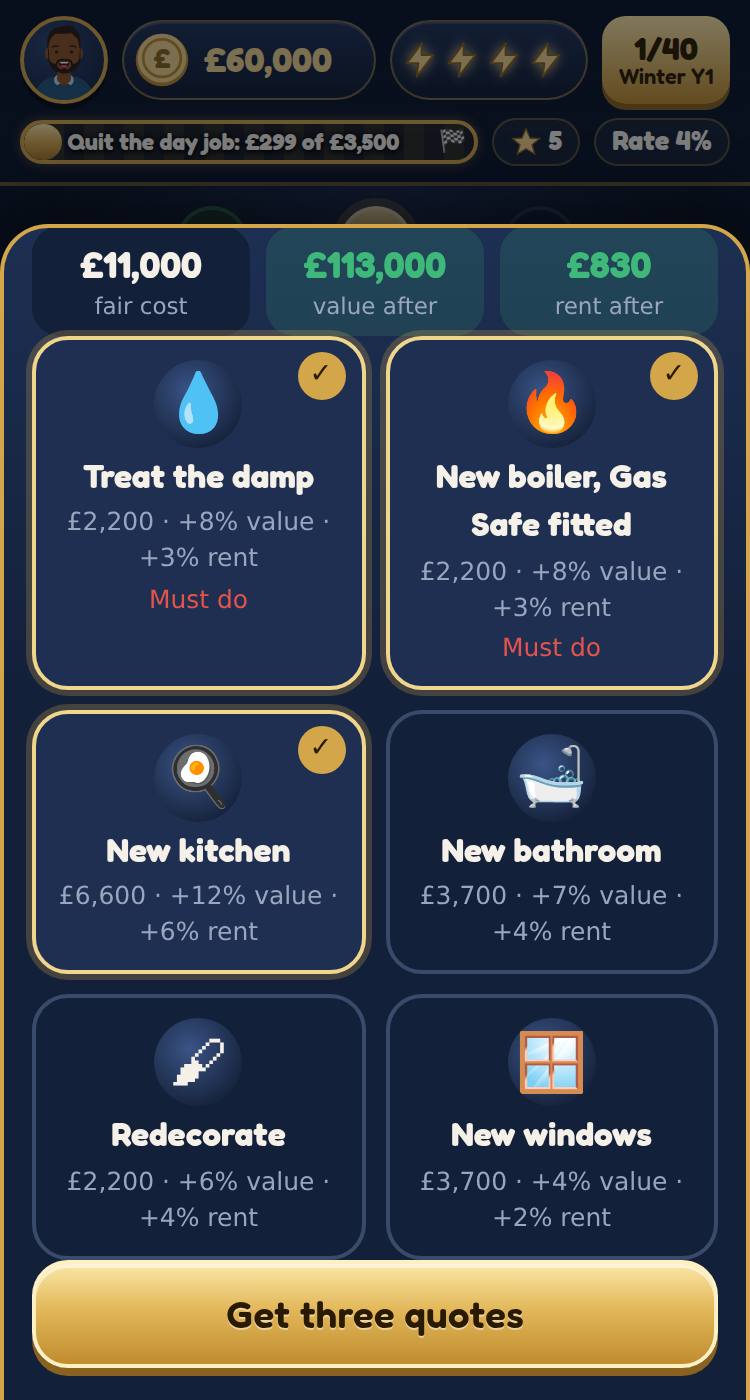
Old homes are cheaper. Fix them up and they are worth more.
- Tap your home, then Plan the works. Steve the Surveyor gives you a brief: add this much value, spend under this much.
- Tap a room on the plan and pick a finish: Leave, Refresh, Renovate or Luxury. Fix dangerous things first, like old wiring.
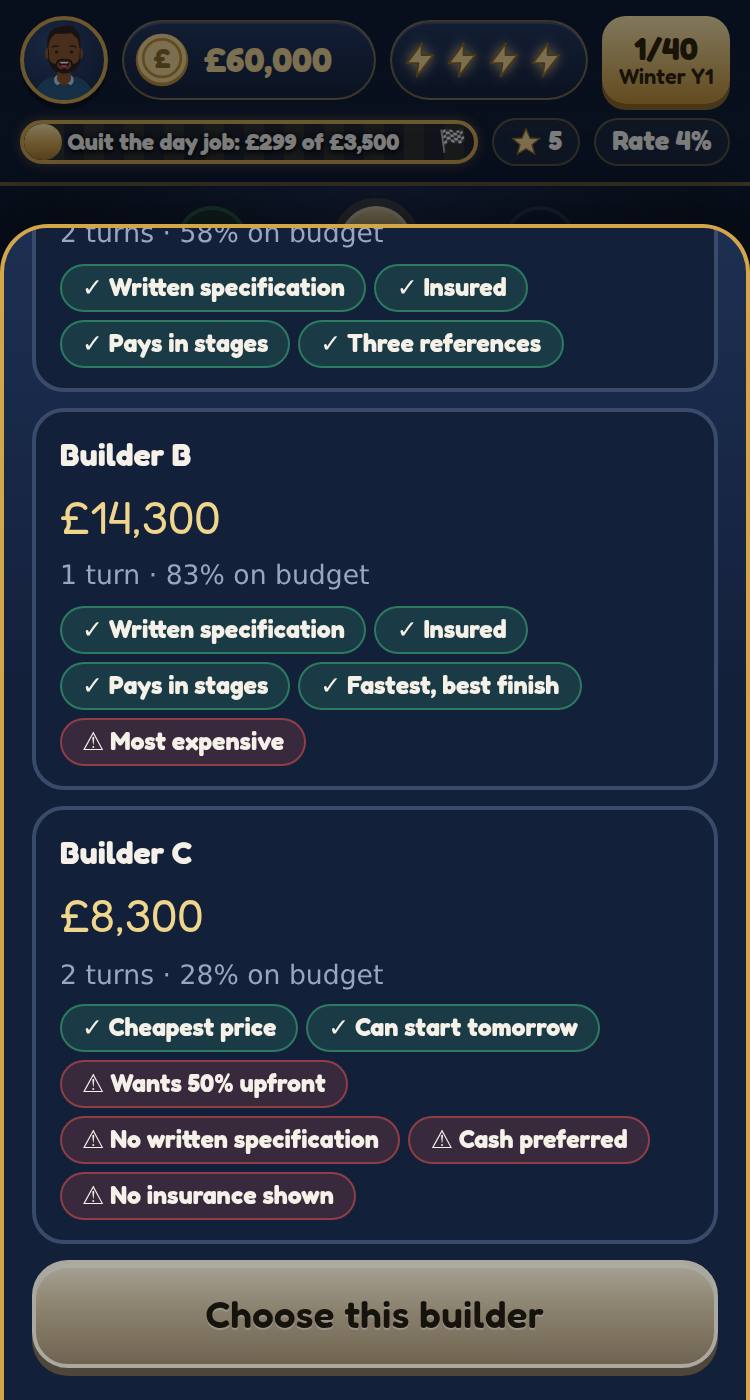
- Watch the meters. Spend past what the street will pay and the money is wasted. Earn three stars and your builder is more likely to finish on budget.
- Pick a builder. Avoid the cowboy: cheap, wants cash up front.
Making an HMO
An HMO is a house where each bedroom is let to a different person. More rent, but more rules and bills.
- Tap an empty house, then 🏘 Plan an HMO. Or visit the Planning Office on your street.
- Tap each room and choose: bedroom, kitchen, bathroom or lounge.
- Fix every ❌ in the rules. Small rooms cannot be bedrooms.
- Some places need planning permission first. Roll the dice at the Planning Office.
- Convert it, then let the rooms.
Turning a shop into flats
Empty shops and offices turn up in Towns and City Centres. They earn nothing until you turn them into flats.
- Buy one with Bella's bridge or cash. Banks will not give a mortgage on an empty shop.
- Open it. Pick a flat letter, then tap the bays that make up that flat.
- Every flat needs enough space, enough windows, and a door onto the stairs. Fix every ❌.
- Ask the Planning Office for permission (a dice roll), then start the works. Bella can lend most of the cost.
- After 3 turns you own the flats. Let them, or refinance to pay Bella back.
Marketing for sellers
Marketing brings motivated sellers to you as cards in your deals. Tap 📣 Marketing on your board (Mo suggests it when nothing on the board suits you). Pick a channel, a budget and how long it runs, then write the advert.
- Each channel suits different sellers. Letters reach owners you choose; leaflets and social ads reach everyone nearby.
- The advert is three quick choices: who it is for, what you promise, and how people reply. After each one you see why it works or does not.
- Up to 3 stars make each lead cheaper and more likely to be a motivated seller. A misleading promise breaks the advertising rules and caps the advert at 1 star.
Tax
Tax works like the real thing, simplified. Alan the Accountant at the Tax Office explains every bill.
- Buying: every home pays purchase tax at the extra home rate: Stamp Duty in England, LBTT in Scotland, LTT in Wales. The deal card shows it.
- Each year: at the end of turns 4, 8, 12 and so on you pay tax on your rent profit or fees. Mortgage interest is not taken off: it earns a 22% credit instead.
- A company: set one up with Alan and the homes you buy after go into it. Interest comes off before tax and profit pays 19% to 25%, but money you draw to live on pays dividend tax.
- Selling: a profit on a sale pays tax on gains.
- Deal cards show the profit after tax at your income, and Mo reminds you a turn before each bill.
- Alan the Accountant is at the Tax Office: tap 🏙 Street. He shows your last bill and what it would have been as a company.
The Weekly Challenge
Every Monday a new challenge starts. Everyone plays the same character in the same region, with the same deals, news and dice, for 20 turns.
- Play it as an Investor or a Sourcer. Each has its own leaderboard.
- Investors score their net worth, Sourcers the fees they earn, times a Compliance Bonus of up to 1.5. Keep every let home legal, or set your business up properly, and a careful player can beat a richer, careless one.
- Play as often as you like. Only your best score counts, under a display name you choose.
The market
House prices go round in a cycle: Recovery, Boom, Slowdown, Recession. Each phase lasts 1 to 2 years. The Market chip on your board shows where you are. Tap it to see what it means for you.
- Boom: prices rise fastest, buyers queue, and lenders lend up to 80%. A good time to refinance or sell. The Bank tends to raise rates.
- Recession: prices fall, buyers are scarce, and lenders lend only 70%. The Bank tends to cut rates. Repossessions come up cheap for anyone with cash.
- Some regions swing harder than others. London moves most, the North East least.
- If a home falls below its loan (negative equity), selling won't clear the debt. Keep the rent coming in and wait for the market to turn.
- The Property Gazette hints when the market is about to change.
Getting your money back out
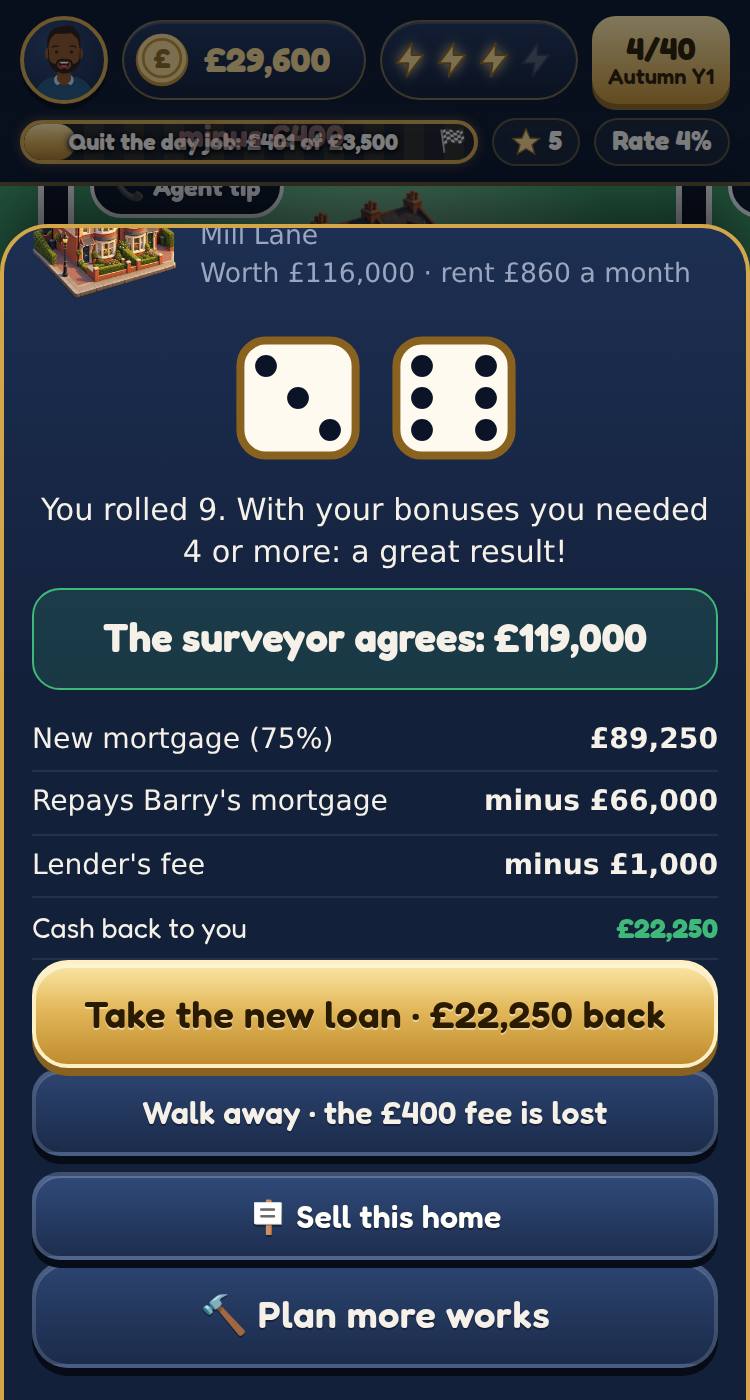
A fixed up home is worth more. Tap Refinance. The bank lends you more, and the extra comes back to you. Use it to buy your next home.
Selling a home
Tap your home, then Sell this home. Pick an estate agent (best price), an auction (fast) or an investor (fastest).
Selling gives you a lump of money, but no more rent from that home.
Playing as a Sourcer
Sourcers do not buy homes. They find bargains for other people and get paid a fee.
- Set up your business with the 🛡 shield.
- Package a bargain home.
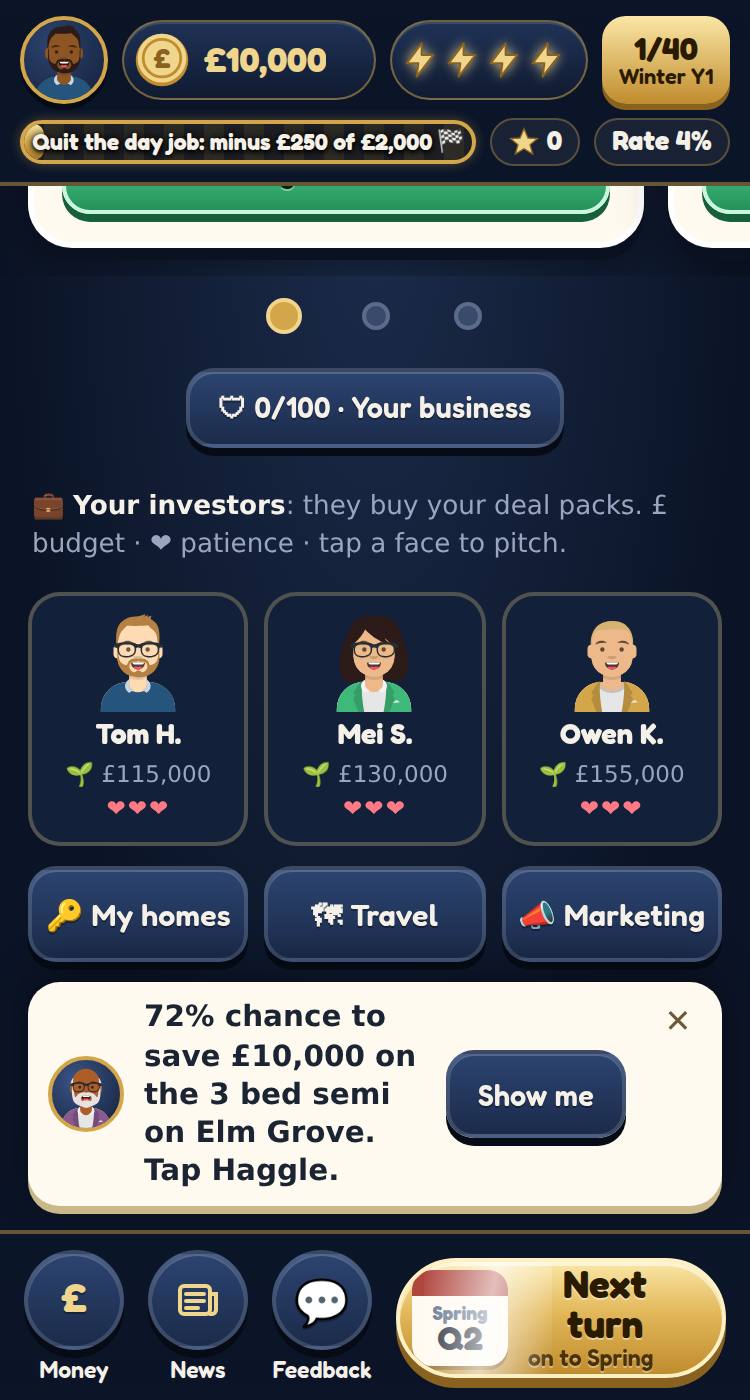
- Tap an investor's face to pitch it.
- Get paid next turn.
Once you reach 8 Reputation you can hire a virtual assistant from the 🛡 shield for an extra ⚡ a turn. You interview them first: find them where you can check their record, ask about real situations, test them, pay fairly and give them their own login, and they turn up every turn.
Your business and AML checks (Sourcers)
Tap the 🛡 shield to set up your business properly. Each item has a short quiz from official sources, its real fee and 1 ⚡:
- AML supervision with HMRC: the law for sourcers. It lets you check where a buyer's money comes from.
- A redress scheme, ICO registration (for handling people's data), indemnity insurance, terms of business, a company and bank account and client money protection.
Your Compliance Score rises with each one. At 80 or more investors are more likely to say yes; below 40, less likely. The biggest investors want 100.
When an investor wants to buy, do the AML check: their ID, where their money comes from, and how they act. Without AML supervision you only see the ID. Something odd? Refuse: a dodgy buyer costs you far more than one lost fee.
Pitching to investors (Sourcers)
- Each investor shows a budget, where they want to buy, what they want (a yield or a discount) and their patience as ❤️ hearts.
- Pick a fee. A higher fee earns more but lowers your chance. The odds panel shows every bonus: a strong pack, the right region, the deal they want, your skill and your Compliance Score.
- A miss costs hearts. No hearts left and they stop taking your calls.
- As your Reputation grows you get more pack slots and bigger investors with bigger fees.
News cards
Each turn starts with a news card and two choices: a rate rise, a broken boiler, a tip off, knotweed, an investor pulling out and more. Read both choices: one is often safe, the other a gamble.
When the market turns, a Boom or Recession card tells you, with a choice to ride it or play safe.
Put the game on your phone
On the start screen tap 📲 Add the game to your home screen. On an iPhone, use Safari's Share button, then Add to Home Screen. The game then opens full screen from its own icon and keeps working without a signal.
Updates arrive by themselves: each time you open it with a signal you get the latest version. On an iPhone the home screen icon can keep its own copy of your game, separate from Safari, so the first time you open it you may need to sign up again and start a new game.
Skills to try
Tap the 🎓 chip at the top of the board to see every skill in the game, such as haggling, auctions, HMOs and writing an advert. Each one you have tried gets a tick, and the rest have a Go button that takes you there. Try them all for the All-rounder badge.
News cards change the game too. A Regeneration card, for example, means new investment in a region: any homes you own there are worth 3% more straight away.
At the end of a game
You get a title for how you played, such as The Yield Hunter or The HMO Specialist, and badges for things like quitting the day job, playing with no hints, keeping every home legal or buying in a Recession. Play again to collect them all.
Top tips
- Stuck? Do what Mo says.
- Keep some spare money. Boilers break!
- Look around a home before you buy.
- Cheap homes in the north can earn the most.
Something confusing? Tap 💬 Feedback in the game and tell us on Skool.
A game for fun and learning, not advice about real money. All numbers are made up to teach you.